
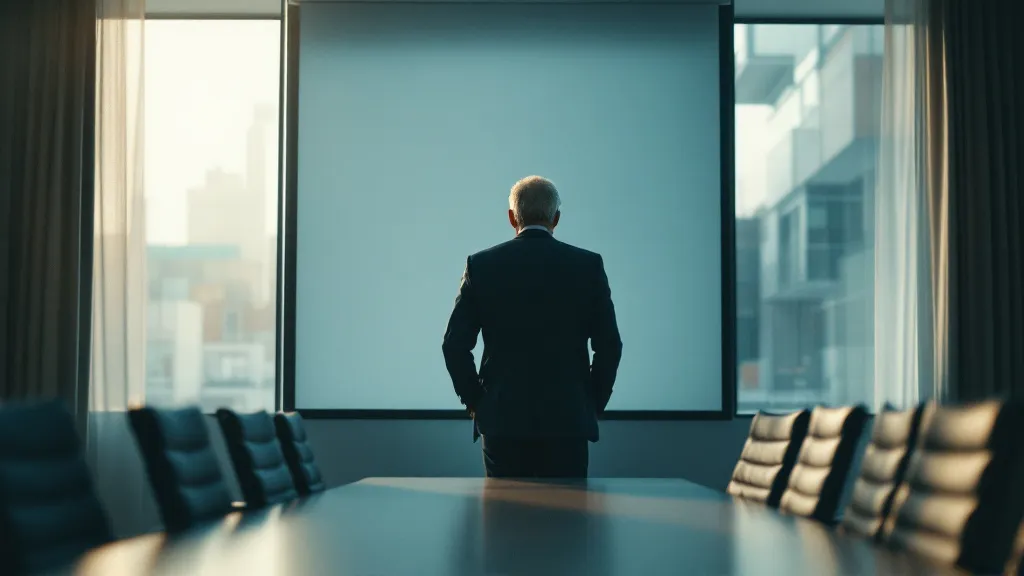
I sat through most of the meeting cycle in which a technology client of mine took nine months to approve a market move they had welcomed, in principle, at the very first meeting. The opportunity had been spotted early. The initial analysis was promising. Everyone around the table agreed the move was worth making, and then they spent three quarters of a year not making it.
The pattern deserves recording, because I have seen it repeated in a dozen boardrooms since. The first review concluded with a request for more market data, which seemed sensible enough. The second, a month later, wanted a fuller financial model. The third commissioned a competitive analysis, the fourth asked for customer validation, and the fifth raised questions about operational readiness. Taken one at a time, every request looked like responsible due diligence. Laid end to end, they were a leadership team paying monthly instalments on a decision nobody wanted to own.
By the time approval finally arrived, a competitor had planted its flag in the space. The window had not slammed shut. It had narrowed to the point where climbing through cost far more and impressed nobody, and the team asked to execute the move had spent the best part of a year watching the opportunity cool on the windowsill. What stayed with me was the chief executive’s own verdict, offered afterwards with impressive candour: “We didn’t decide not to do it. We just decided not to decide. And by the time we decided to decide, it was too late for the decision to matter.”
I have repeated that sentence in more boardrooms than I can count. It names the most expensive leadership failure I know, and the least visible one. Nobody writes “declined to decide” in the minutes. The cost never appears on a spreadsheet. It turns up months later, dressed as bad luck.
The third request for more data is not about the data
For years I held a belief that sounds unimpeachable: better decisions come from more information. Up to a point it is even true. You would not want a pilot skipping the weather briefing, or a builder pricing a roof he has never climbed a ladder to look at.
The point arrives much earlier than most of us care to admit. Every significant decision reaches a stage where additional analysis produces marginal insight and substantial delay. The model grows more detailed while the fundamental picture stays exactly where it was. The data gets refined while the answer it points to refuses to change. Meanwhile the weeks spent chasing the final two per cent of certainty are spending something nobody has thought to price: the opportunity that was sitting there, warm and available, back at round one.
My rule of thumb, after twenty years of running my own business and a good many more advising other people’s, goes like this. The first round of information gathering is essential. The second is useful. The third is usually a sign that someone at the table does not want to decide. They generally know the right answer, often with uncomfortable clarity. What they want is to postpone the moment of being responsible for it, and a request for further analysis performs that service beautifully while looking like diligence. Nobody in the history of commerce has ever been criticised for asking to see more evidence.
Thoroughness and avoidance wear the same suit, which is what makes this failure so durable. The tell is not in the request itself. It sits in what changed between rounds. When round three delivers a more detailed version of the answer round one delivered, the team is no longer analysing anything. It is redecorating a conclusion.

Reacting is not deciding either
Fairness demands I describe the opposite failure, because I have watched it wreck things just as thoroughly. I worked with a financial services firm whose chief executive, rattled by a competitor’s announcement, restructured his entire sales division over a single weekend. No consultation. No modelling of the consequences. The organisation his people had left on Friday evening no longer existed on Monday morning, and neither did the logic connecting the announcement to the response.
The results arrived faster than any market analysis could have. Within weeks his best sales managers had left or quietly downed tools. Client relationships built over years wobbled, and revenue in the following quarter fell by more than the competitive threat would ever have taken. When I later asked what evidence had informed the restructure, he gave me the most useful answer I heard all year: none. It had been a reaction, and the business paid the difference between a reaction and a decision.
Reactive moves feel decisive from the inside. The leader is visibly in motion, and motion is easily mistaken for progress. Speed without direction is panic with better optics.
The discipline I want to argue for sits between these two ditches, and in my work it carries the name Velocity of Decision: the sustained ability to make timely, considered decisions under conditions of uncertainty. The word velocity earns its place, though people mishear it as a fancy synonym for haste. Velocity is speed with a direction attached. Haste is what the weekend restructure had.
Here is the reframing that took me longest to accept in my own leadership. A delayed decision is still a decision. The moment you say “let’s revisit this next quarter”, you have not postponed anything. You have decided that three months of inaction is preferable to the discomfort of acting now, and your organisation will live with that choice whether or not you ever call it one. Wait long enough and circumstances will decide for you. I have watched circumstances chair that meeting many times, and they are the worst director you will ever appoint. They never prepare, they never explain, and they have never once taken the blame.

The best decision I never had the numbers for
My own education in this discipline did not come from a client. It came from an empty desk. My tax advisory practice was a boutique in a market full of giants; most of our competitors could have swallowed us without noticing. What we could not match in scale we matched in care, in the work itself and in the hiring. The big firms tended to throw whoever was available at a problem and let supervision mop up afterwards. We took the opposite view. The right person mattered more to us than the available one.
One day somebody came onto the market who we all knew was exceptional. The fit was almost embarrassing, in temperament and in technical standard. There was a single difficulty, which was that I had no work for them to do. There was also a clock, because talent of that order attracts other offers within days. So I made the call quickly. I put an attractive offer in front of them before I had a single billable hour to set against it, and they accepted, which left a healthy salary walking out of the door every month with nothing walking in.
People told me it was reckless, and by the textbook they were right. You recruit to the need. You wait until the workload strains, then you hire. What the textbook misses is that the decision in front of me was never the one it described. Talent like that does not sit on the shelf while you get comfortable, so the real choice was between deciding with incomplete numbers that week and declining by default the week after. I reasoned it through in the time the situation actually offered, which is a different thing entirely from not reasoning at all. Then we went out and generated the work to keep them busy. It succeeded so well that it stopped being an emergency measure and became how we operated. When someone properly good became available, we hired them, then found the work. We still do.
There was a second dividend I had not fully priced. Carrying that extra talent meant we nearly always held capacity in reserve, so when a client rang with a deadline that had crept up on them, we could say yes and deliver while leaner firms were explaining their lead times. The criticism never entirely went away. Neither did the results.
What I understood only later, once I had the vocabulary for it, is that I had stumbled onto the most useful distinction in this whole discipline: the line between reversible and irreversible decisions. That hire was recoverable. Had it failed, we would have parted company sadder and slightly poorer, and the firm would have carried on. Decisions of that kind should be made quickly, and agonising over them is a tax on everyone’s energy. Irreversible decisions deserve slower handling, because the cost of getting them wrong is permanent. Even those have a shelf life, though. Leave one on the table long enough and the choice quietly evaporates, and what remains is whatever the delay has built around you.

Put a date where the delay can see it
Decision velocity looks like temperament from the outside, some people apparently born with the stomach for the call. Up close it is a set of habits, and habits can be taught.
The first is ownership. A remarkable share of delay is really ambiguity about authority, the decision bouncing between individuals, committees and governance layers while everyone assumes the final say lives somewhere else. Settle who decides what, and at which level, and half the friction disappears before any courage is required.
The second is the practice I now press on every team I work with: put a decide-by date on every significant issue. Not review by. Not discuss by. Decide by. “We’ll come back to this when we have more information” is permission for indefinite delay, renewed at every meeting without anyone signing for it. “We will decide this at the March board” is accountability with a date attached. Writing that date down changes the conversation more than any speech about decisiveness ever has, because it makes the waiting visible, and visible waiting has to be defended out loud.
Proper debate followed by proper commitment comes third. The best teams I have seen argue hard, disagree openly, then commit fully once the call is made, including the people who argued against it. A decision quietly undermined by those who never accepted it moves slower than no decision at all, and costs more, because it looks like progress while behaving like sabotage.
The last habit is the willingness to adjust. Deciding under uncertainty means being wrong sometimes; that is the price of the ticket. A wrong decision made in time and corrected on the evidence almost always costs less than a non-decision left to drift, for the simple reason that a decision has an owner and a drift has none.
The compound effect on an organisation is hard to overstate. When leaders decide clearly and promptly, everything beneath them moves differently. Teams commit because the direction can be trusted to hold. Managers spend budgets rather than guarding them. Initiative flows, since people believe the ground will still be there tomorrow. When leaders hesitate, the whole structure enters a holding pattern, and an organisation with a sound strategy, capable people and a favourable market but no decision-making is a bit like a car packed for a road trip with no petrol in it. Everything is ready. Nothing moves.
Underneath the mechanics sits the personal matter, and I will not pretend it away. Deciding under uncertainty takes courage, because the arithmetic of blame is lopsided: the reward for a good call is shared, while the bill for a bad one arrives with your name on it. Avoiding the decision does not avoid the responsibility. It merely converts it into the consequences of inaction, which nobody owns, and which are usually worse. Leaders are not paid to eliminate uncertainty. They are paid to decide despite it.
Velocity of Decision is the fourth of the five disciplines in the RESOLVE framework, the architecture at the centre of my book, The Leader with Resolve, out now. Each essay in this series takes one discipline into working detail, and this one carries a particular weight, since deciding in time is what converts the other four from good intentions into movement.
If there is a decision circling your boardroom that this essay has made uncomfortably recognisable, I would welcome a diagnostic conversation about it. You can also take the free RESOLVE diagnostic: two minutes of your time, it asks nothing in return, and it will show you where your own leadership is quickest to wait.